
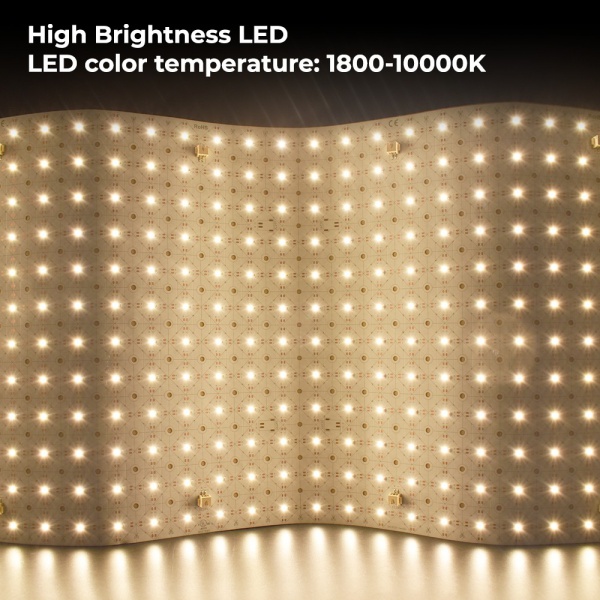
An LED light sheet is a thin, flexible circuit board covered in a grid of small LEDs, built to light a whole surface evenly from behind. It runs on low-voltage DC (12V or 24V), can be cut to size along marked lines, and is mainly used to backlight translucent stone, signs, light boxes and display panels.
Where an LED strip is a single line of light, a light sheet is an area of light. That one difference is why sheets are chosen for backlit onyx walls, bar fronts and thin light boxes: they spread light across the surface instead of leaving bright stripes and dark gaps.
How an LED light sheet is built
- Base: a double-layer flexible printed circuit (FPC). It bends to follow gentle curves and lies flat on a backing panel.
- LEDs: SMD2835 or SMD5050 chips placed in a regular grid. Higher LED density means a more even glow at short distances.
- Cut lines: every module on the grid is a complete circuit, so the sheet can be cut between modules to fit the panel. On JJS sheets the cut unit ranges from 25 × 25 mm (1 inch) to about 61 mm, depending on the model.
- Power: 12V or 24V DC from a separate LED driver. 24V is the usual choice for larger surfaces because it handles longer runs with less voltage drop.

LED light sheet vs LED strip
| LED light sheet | LED strip | |
|---|---|---|
| Light output | Even area of light | Lines of light that need spacing and diffusion |
| Typical depth behind stone | Shallower for the same uniformity | Deeper, or more strips closer together |
| Installation | Lay and stick one sheet per area | Many parallel runs, each wired separately |
| Cutting | Cut to shape on a grid | Cut to length only |
| Best for | Backlit stone, light boxes, display panels | Coves, edges, linear accents |
LED strip is cheaper per metre, but on a large backlit surface the labour of laying and wiring many runs, plus the risk of visible stripes, usually makes a sheet the better choice. For a deeper comparison on stone, see LED sheet vs strip for backlit stone.
Types of LED light sheet
| Type | What it does | Example JJS model |
|---|---|---|
| Single color | One fixed white, from warm 1800K to cool 20000K | 242 LEDs, 490 × 245 mm, CRI 95+ |
| CCT (tunable white) | Adjusts between warm and cool white | 484 LEDs, 2700K + 6500K |
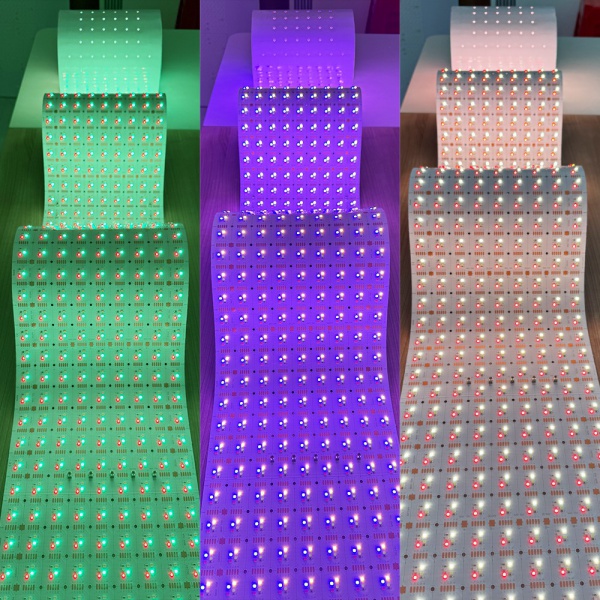
| RGB | Full color effects | 128 LEDs, 490 × 245 mm |
| RGBW | Color plus a dedicated white channel | 288 or 512 LEDs, 490 × 245 mm |
| RGBCCT | Color plus warm and cool white | 360 or 640 LEDs |
| Addressable (pixel) | Each pixel controlled separately for animation | 32 pixels per sheet, or 100 pixels on 10 × 10 in |
| Long roll | Continuous 100 m sheet, 240 mm wide, cut to length | RGBW or CCT, 24V |
Specifications to check before you buy
- Voltage: 12V or 24V. Match it to the driver and the size of the job.
- LED density and cut size: more LEDs and smaller cut units give better uniformity and a closer fit to odd shapes.
- Power per sheet: JJS sheets range from about 12W to 60W per sheet. This sets the driver size.
- Color temperature and CRI: for stone and wood, CRI 95+ shows natural color more accurately.
- IP rating: IP20 for dry indoor panels; IP54 where some moisture protection is needed.
Where LED light sheets are used
- Backlit onyx, marble and agate walls, bar fronts, kitchen islands and reception desks
- Sign light boxes and illuminated graphics
- Retail display cabinets and shelves
- Translucent acrylic, resin and fabric panels
How to choose the right sheet in four steps
- Start with the material. Stone thickness and translucency decide how much light and how much distance you need. Test a real sample.
- Set the cavity depth. Around 50 mm between the sheet and the stone is a common starting point; below 30 mm, add a diffuser.
- Pick the color and control. Single white for most stone; CCT for adjustable mood; RGBW or RGBCCT for color effects.
- Size the power. Add up the sheet wattage, leave headroom on the driver, and split large walls into zones. The LED light sheet calculator does the sums.
Common mistakes
- Choosing the sheet before testing the actual stone or diffuser
- Cutting outside the marked cut lines, which kills that section
- Sizing the driver after the sheets are already mounted
- Running one long chain on a large wall, so the far end dims
- Sealing the driver where no one can reach it for service
FAQ
Can LED light sheets be cut?
Yes, but only on the marked cut lines between modules. Each piece then needs its own power connection.
Do LED light sheets get hot?
They run warm, not hot, but drivers and enclosed cavities still need some ventilation.
How long do they last?
JJS rates its sheets at 36,000 hours or more, and all products carry a 5-year warranty.
12V or 24V?
24V for most projects; 12V for small panels or when matching existing 12V equipment.
Can I get a sample?
Yes. Testing a sample behind your own stone is the most reliable way to confirm brightness and evenness before ordering. Request a sample.
Related: flexible LED light sheets · how far the sheet should sit from the stone · how to cut and install LED light sheets