
Short answer: most quartz countertops cannot be backlit. Standard engineered quartz is made to be opaque, so light behind it simply doesn’t come through. A handful of designs are made translucent on purpose, and natural quartzite such as Cristallo or Patagonia does let light through. If you want a countertop that glows, choose one of those, or go to onyx, agate or another translucent stone.
We make the LED sheets that go under backlit countertops, and “can you backlight my quartz?” is one of the questions we get most. Here is how we answer it.
Quartz vs quartzite: the name causes most of the confusion
| Material | What it is | Can it be backlit? |
|---|---|---|
| Engineered quartz (most kitchen quartz) | Crushed quartz bound with resin and pigment, made opaque | No, for almost all colors |
| Translucent engineered quartz | A few designs made to pass light, often in thinner slabs | Yes, in the specific designs and thicknesses the maker approves |
| Natural quartzite (Cristallo, Patagonia and similar) | Natural stone; some varieties are translucent | Often yes; test each slab |
| Onyx, agate, translucent marble | Natural translucent stone | Yes; the usual choice for a backlit countertop |
So when someone searches for “lighted quartz countertops”, they usually mean one of two things: a translucent engineered quartz design, or a natural quartzite. A regular white quartz slab from the showroom won’t glow, whatever LEDs you put under it.
Which engineered quartz can be backlit
Only designs the manufacturer lists as backlightable. Two examples we know of:
- Cambria says backlighting is available in select designs and thicknesses. Its backlighting guideline lists Brittanicca Warm and Brittanicca Gold Warm (1 cm), Skara Brae (1 cm) and Brighton (2 cm).
- Vicostone Chalcedony is named in an ISFA Countertops Magazine article as a quartz surface that can be backlit.
Check the current list with the manufacturer or your fabricator before you order. The approved designs change, and the thickness matters: the same design at 3 cm may not pass enough light.
Cambria’s own guideline asks for at least 1,000 lumens per square foot behind the slab and recommends 6500K cool white, because warmer light looks amber through its material. It also points out that the stone must be supported by the cabinet and substrate, never by the light panel.
Natural quartzite: often the better “quartz look”
If you like the clean, white quartz look but want it to glow, a translucent quartzite is the closest match. Cristallo and Patagonia are both sold as backlit slabs. Being natural stone, each slab passes light differently. Thick or dense areas stay darker, so light a piece of the real slab before you commit.
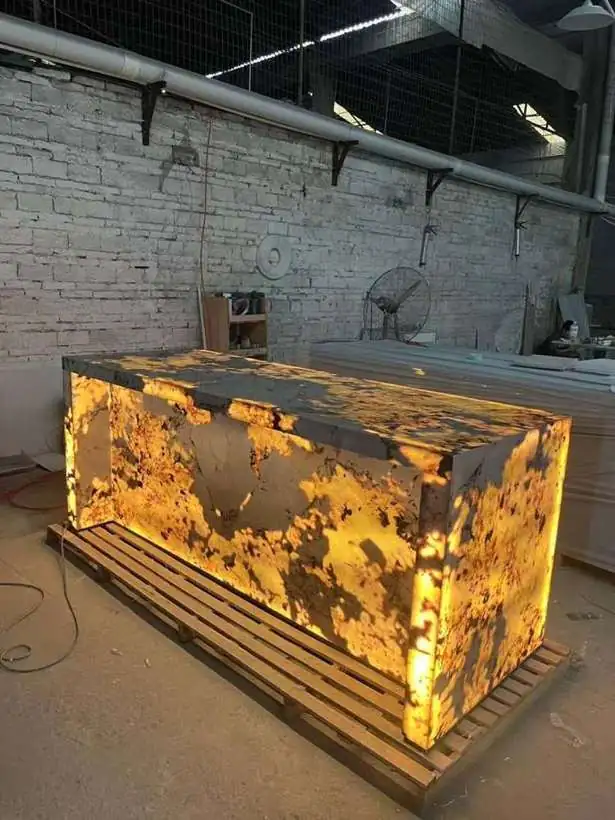
If your countertop can be backlit: what to put under it
- Light source: a flat LED light sheet or panel, not strips. A countertop needs one even glow across the whole surface.
- Gap: about 30–80 mm between the LEDs and the stone, depending on the stone and the sheet. Thin, very translucent slabs show LED dots most, so they need a denser sheet or more gap. See how far LED sheets should be from stone.
- White: cool white (around 6500K) for white quartz designs and white quartzite; warm white for honey onyx. If you are not sure, a tunable sheet lets you set it with the slab in place. See color temperature by stone.
- Brightness: ask the light supplier for lumens per square foot, and compare it with what the stone maker asks for.
- Support and service: the cabinet carries the slab; the sheets sit on a backing panel or removable tray, with drivers in an accessible cabinet.
Our flexible 24V sheets are made for exactly this: single color from 1800K to 10000K, tunable white 2700K–6500K, CRI 95+, cut along marked lines around sinks and cooktops, with a 5-year warranty. More on the full build in backlit stone countertops and custom LED stone lighting.
How to check your own slab
- Ask the fabricator or brand whether the exact design and thickness is approved for backlighting.
- Hold a strong flashlight against the back of an offcut in a dark room. If almost nothing comes through, stop there.
- If it glows, test it over an LED sheet at the gap you plan to build, at night, with two different whites.
- Look for LED dots, dark patches and color shift before you order the full layout.
FAQ
Can I backlight my existing white quartz countertop?
Almost certainly not, unless it is one of the few translucent designs. Standard engineered quartz is opaque.
Is quartzite the same as quartz?
No. Quartzite is a natural stone; quartz countertops are engineered. Some quartzites, such as Cristallo and Patagonia, are translucent enough to backlight.
What color temperature for backlit quartz?
Cool white around 6500K for white designs, which is also what Cambria recommends. Warm light tends to look amber through these materials.
Which stone is easiest to backlight for a countertop?
Onyx, especially honey and amber onyx, then agate panels and translucent quartzite. See onyx vs marble vs quartzite.
Have a slab or a design in mind? Send the stone name, thickness and panel size, and we will tell you whether it is worth backlighting and suggest a sheet layout. Request a quote or a sample.
Sources: Cambria backlighting; Cambria product guideline for backlighting (25L-0304); ISFA – Backlighting Translucent Surfacing Materials.