
Short answer: for most backlit onyx countertops and kitchen islands, a 24V flexible LED light sheet is the best fit. It spreads light over the whole surface, sits 30–80 mm behind the stone, cuts around sinks and cooktops, and can be replaced without lifting the slab if you mount it on a tray. Look for CRI 95+ on the white channel, a white you have tested on your own slab, and a supplier that gives you a layout and power plan.
We make LED light sheets in Shenzhen, so we are not neutral. Below we explain the four kinds of lighting people use behind stone, where each one works, and what to ask any supplier — including us.
The four options behind a backlit countertop
| Type | What it is | Works well for | Watch out for |
|---|---|---|---|
| Flexible LED light sheet | A grid of LEDs on a thin flexible board, cut along marked lines | Countertops, islands, bar fronts, walls, shapes with cutouts | Needs a 30–80 mm gap; quality varies a lot between factories |
| Modular rigid panels | Small square panels (often about 300 mm) joined edge to edge | Simple rectangles, installers who want a plug-and-play kit | Seams between panels; less flexible around curves and cutouts |
| Edge-lit light guide panels | LEDs along the edge of an acrylic panel that spreads the light | Very shallow cavities, signs, thin wall panels | Lower output through thick or dark stone; sizes are fixed or made to order |
| LED strips in rows | Parallel strips on a backing board, often with a diffuser | Narrow areas, coves, deep cavities, small budgets | Stripes if the gap is too small; much more cutting and wiring |
For a full countertop or island, the choice is usually between a sheet and modular panels. Strips make sense when the lit area is a line, not a surface.
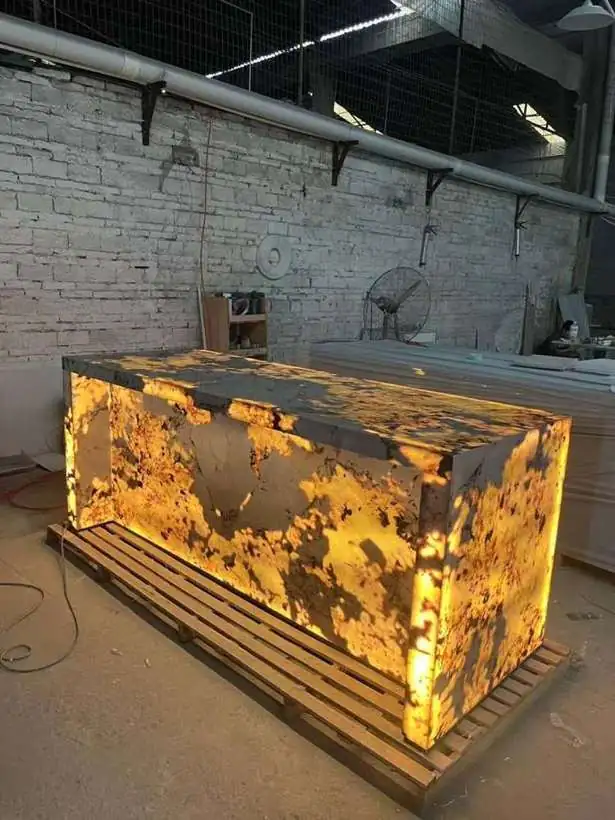
What makes one LED sheet better than another
Most LED sheets look alike in a photo. The differences show up after the stone goes on.
- LED density. More LEDs per square meter means a smaller gap for the same evenness. If your cavity is shallow, ask for a denser sheet or a lens sheet, not a brighter one.
- CRI of the white channel. Ask for the figure in writing. 90 is the minimum for stone; our white channels are 95+. On RGBW and RGBCCT sheets the white and color channels are different, so ask about the white.
- Color temperature choice. Warm 2700–3000K for honey and amber onyx, 4000K or above for white marble. A tunable sheet (warm plus cool white) lets you decide on site.
- Voltage drop. On a long island, a cheap thin board gets dimmer at the far end. Ask where the power feeds go and how many sheets one feed can carry.
- Cutting. Check the cut interval. A sheet that cuts every 22–30 mm fits around sinks and cooktops with less dark edge.
- Batch consistency. Sheets from different batches can differ slightly in color. Order spares from the same batch.
Specification we would use for an onyx island
| Item | What to specify |
|---|---|
| Voltage | 24V DC |
| CRI | 95+ on the white channel |
| Color temperature | Tested on your slab; tunable 2700–6500K if undecided |
| Gap to stone | Start at about 50 mm; confirm with a sample |
| Mounting | Fixed backing panel or removable tray, never bonded to the stone |
| Drivers | Sized at 80% load, in a cabinet with a normal door |
| Zones | Large islands split into zones so one fault darkens one zone |
| Protection | IP54 sheets near sinks; the stone and its support must carry the load, not the LEDs |
| Warranty | Ask how many years and who pays shipping for replacements |
Questions to ask any supplier
- Can you light a piece of my stone and send photos at two color temperatures?
- What is the CRI of the white channel, in writing?
- How many LEDs per sheet, and what gap do you recommend for my stone?
- Will you send a layout showing how the sheets cover my panel, with power feed points?
- What driver and controller do you recommend, and at what load?
- Can I get spare sheets from the same batch?
- What is the warranty, and how are replacements handled?
- What certifications does the exact product have? Ask for the certificate, not a logo.
A good supplier answers these without hesitation. If a supplier cannot say what gap to use or will not test your stone, keep looking.
Where JJS fits
We make the flexible sheet option: single color from 1800K to 10000K, tunable white, RGBW and RGBCCT, all 24V, CRI 95+ on the white channel, with a 5-year warranty. Orders start at one sheet, and paid samples arrive in 7–10 days. Every project gets a free layout, power plan and wiring diagram. More on how we plan custom LED stone lighting.
We are a good fit for stone distributors and fabricators who want factory-direct sheets and help with the layout. If you want a boxed plug-and-play kit from a local stockist, a modular panel system may suit you better.
- 610×305 mm single color sheet — our standard choice for onyx countertops
- Tunable white sheet, 2700K–6500K — when the white is not decided
- RGBCCT sheet — color effects plus accurate white
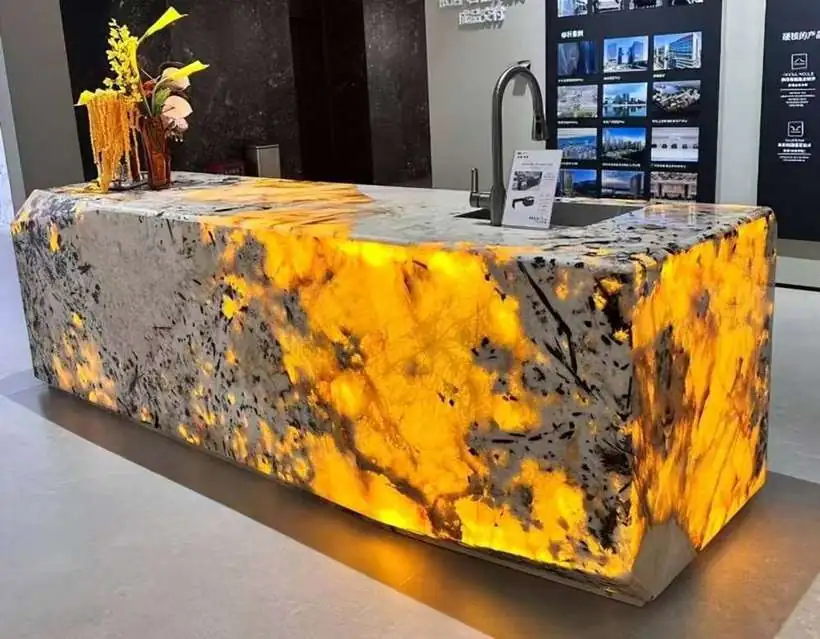
FAQ
What is the best LED light for a backlit onyx countertop?
A 24V flexible LED light sheet with CRI 95+ on the white channel, mounted 30–80 mm behind the stone on a removable backing. It gives an even glow across the whole surface and can be cut around sinks and cooktops.
Are LED strips good enough for a backlit island?
They can work with a deep cavity and a good diffuser. In a shallow cavity they tend to show stripes, and they take much longer to install on a large surface. See LED sheet vs strip for backlit stone.
How far should the LEDs be from the onyx?
About 50 mm is a good start, 30–80 mm depending on the sheet density and the stone. Confirm it with a piece of your actual slab. More in our distance guide.
Warm or cool white for onyx?
Warm 2700–3000K for honey and amber onyx; 4000K for white onyx if you want it to read white. See color temperature for onyx, agate and marble.
Can I buy LED light sheets directly from a factory in China?
Yes. We sell factory-direct from one sheet, with samples in 7–10 days. Send the stone type, panel size and a photo to sales@ledsheetlights.com or request a quote, and we reply with a layout within 1–2 working days.