
An LED light sheet for backlit stone is not just a lighting product. In a real project it becomes part of the stone system, the millwork, the electrical design, and the final visual result. Designers may focus on the glow, but fabricators and contractors also have to consider material translucency, cavity depth, sheet size, voltage, cable exit, power supply capacity, dimming, access for service, and how the panels will be installed behind the stone.
Related project planning links: LED light sheets for stone fabricators.
This guide is for stone fabricators, interior designers, lighting contractors, and project buyers who are planning illuminated onyx, marble, quartzite, resin panels, acrylic stone, bar counters, reception walls, hotel lobbies, and luxury feature walls. If you only need a quick early estimate, start with the backlit stone LED calculator or the general LED light sheet calculator. If the project already has drawings, send them for layout review before production.
Quick Answer
LED light sheets work well for many backlit stone projects because they can provide a shallow, modular, and more uniform lighting surface than a strip-only layout. The final result still depends on the real stone, thickness, veining, cavity depth, diffusion, voltage, wiring zones, power supply sizing, and sample testing. A good design should be reviewed as a complete system, not as a simple area calculation.
Where LED Light Sheets Fit Best
flexible LED light sheets are usually strongest when the project needs a thin backlight, wide illuminated area, custom cutting, or a cleaner installation behind translucent material. They are often selected for backlit onyx walls, stone bar counters, hotel reception desks, light boxes, retail displays, elevator lobbies, and decorative panels where a visible strip pattern would be risky.
They are not automatically the right answer for every stone. Some stone has low translucency, strong veins, dark patches, or inconsistent resin backing. In those cases, the light sheet may still work, but the layout should be tested with the real sample and adjusted before a bulk order.
| Project factor | Why it matters | What to check |
|---|---|---|
| Stone translucency | Controls how much light passes through the slab | Test the real sample instead of relying on a catalog photo |
| Stone thickness | Affects brightness, color shift, and hotspot risk | Confirm thickness and backing before layout |
| Cavity depth | Changes uniformity and shadow softness | Leave enough distance for the LED pitch and material |
| Voltage | Affects current, wiring, and voltage drop | Match sheet, driver, and controller voltage |
| Control type | Single color, CCT, RGBW, and DMX need different systems | Choose controller after selecting LED sheet type |
| Service access | Power supplies and controllers may need maintenance | Do not bury all electrical parts behind fixed stone |
Material Testing Comes Before Final Layout
For backlit stone, the material is often the biggest variable. Onyx can transmit light beautifully, but strong veins may appear brighter or darker. Marble and quartzite can be more difficult depending on density and mineral structure. Acrylic stone and resin panels may look more predictable, but they can still change the apparent color temperature. Use the translucent stone backlighting LED light sheets page as a starting point, then test the actual material.
A sample test should check brightness, color temperature, hotspot visibility, edge shadows, and whether the stone looks better with warm white, neutral white, cool white, tunable white, or RGBW. The goal is not only to make the stone bright. The goal is to make the stone look intentional, even, and serviceable in the final interior.
Backlit stone section: material, cavity, LED sheet, and service access
A backlit stone result depends on the whole section, not only the LED sheet. The stone transmission, air gap, diffuser choice, support board, cable exit, and service access all affect the final appearance and maintenance plan.
Layout Planning: Sheet Count, Cutting, and Zones
Start with the visible illuminated area, not with the size of the raw sheet. Mark the stone opening, hidden frame overlap, cable exit, support structure, and any area where light should stop. Then decide how many sheets are needed and whether the project should use full sheets, cut sheets, or a custom layout.
Early estimates can be made with the LED light sheet calculator, but the calculator should not replace final electrical review. It helps estimate sheet count and load. The final drawing should still confirm cut marks, wiring points, feed direction, and whether leftover pieces will be used.
- Keep LED sheets aligned to the actual visible panel, not only to the stone slab size.
- Avoid random cutting. Cut only where the product allows cutting.
- Plan cable exits before the stone or millwork is closed.
- For large walls, divide the layout into serviceable power zones.
- Leave space for power supplies and controllers in accessible areas.
Example planning case: backlit onyx wall panel
This example is a planning scenario, not a finished customer case. For a backlit onyx wall panel, the team should separate the visible stone area from the hidden frame overlap, confirm where cables can exit, and divide the LED sheets into zones that can be tested and serviced. The same logic applies to bar fronts, reception counters, and feature walls.
Power Supply and Controller Planning
The power supply must match the voltage and total load of the selected sheet layout. A 24V system is often preferred for larger layouts because it can reduce current compared with 12V, but the correct choice depends on the product, distance, load, and controller. Use the LED light sheet power supply calculator for an early capacity estimate and the LED light sheet power supply and controller guide for control planning.
Do not select a controller only because it has a large wattage rating. The channel type must match the LED sheet. A single-color sheet needs a single-color dimmer or PWM controller. Tunable white needs CCT control. RGBW sheets need a compatible four-channel system. DMX projects need a proper decoder and addressing plan.
| Lighting type | Typical control need | Common project use |
|---|---|---|
| Single color | PWM dimmer or single-color controller | Stone walls, signs, displays, warm white architectural lighting |
| Tunable white | CCT controller | Projects that need warm-to-cool adjustment for stone samples |
| RGBW | RGBW controller or DMX decoder | Decorative panels, hospitality features, branded interiors |
| Large zones | Multiple drivers and feed points | Hotel walls, bar counters, long retail displays |
Hotspots, Voltage Drop, and Uneven Brightness
Hotspots usually come from a combination of LED pitch, shallow cavity depth, insufficient diffusion, reflective surfaces, or stone that reveals the light source pattern. Voltage drop is different: it usually appears as dim ends, color shift, or uneven brightness along longer cable runs. Both problems are easier to solve before installation than after the stone is fixed.
The safest approach is to test the real material, confirm spacing, split large areas into zones, use correct wire gauge, and keep power feed points practical. Avoid assuming that a single number such as 70 mm applies to every stone and every sheet type.
Frame shadow, seams, supports, and dark edges
Uneven light is not always caused by the LED sheet. Thick support ribs, deep frames, narrow cavities, cable shadows, and stone seams can create dark areas even when the light source is working correctly. Mark these mechanical risks on the drawing before the LED layout is finalized.
RFQ Details to Send Before Production
To get a useful layout and quote, send the visible size, total quantity, stone or panel material, thickness, target color temperature, voltage preference, drawing, installation depth, cable exit location, and control requirement. If the project is already in design, use the request a custom LED light sheet quote page and include drawings or sketches.
The more specific the RFQ, the more useful the answer. A request that only says “I need LED sheets for stone” usually leads to more questions. A request with size, material, depth, and control method can be turned into a practical layout much faster.
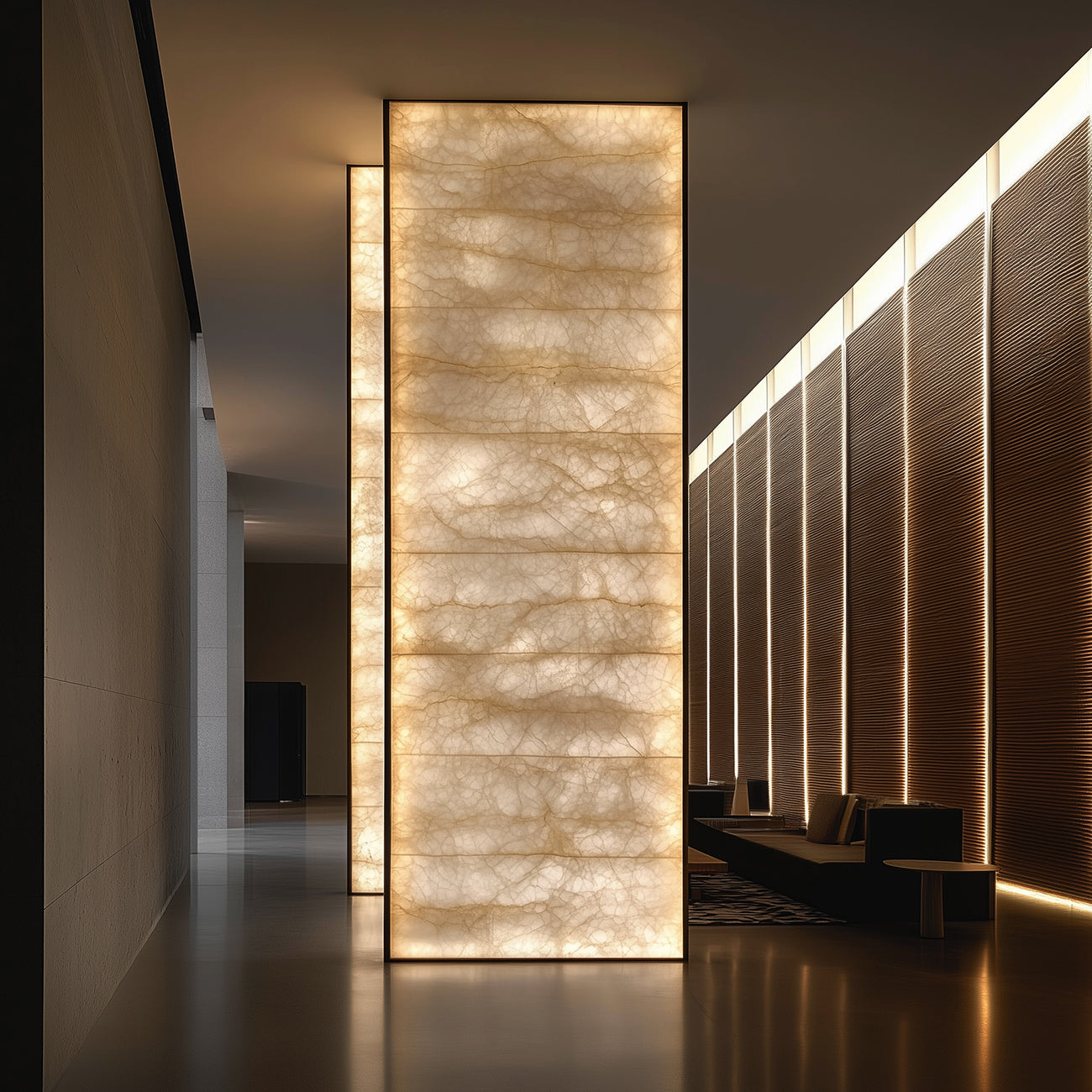
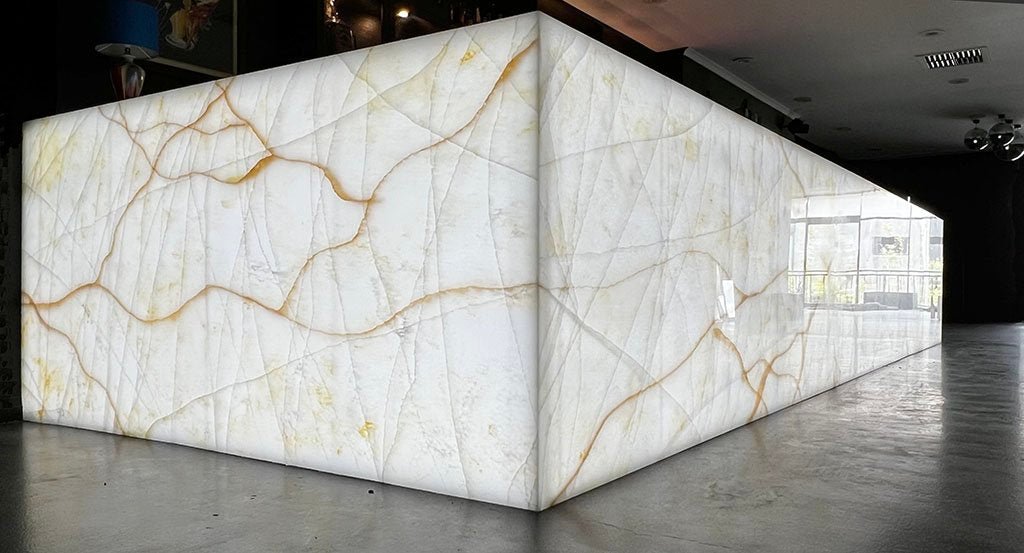
Reference Images for Planning Discussion
The following reference applications show why backlit stone planning should include material testing, cavity depth, wiring zones, and service access.
FAQ
Can LED light sheets remove all hotspots in backlit stone?
No. They can reduce hotspot risk when the layout, material, depth, and diffusion are planned correctly, but no supplier should promise a guaranteed hotspot-free result for every stone. Sample testing is still recommended.
Are LED light sheets better than LED strips for backlit stone?
For shallow and wide surfaces, LED light sheets often create a cleaner and more uniform backlight. LED strips may still be useful for edges, small details, or deeper cavities. The right choice depends on the project.
Can I calculate the final project only by square footage?
Area is a useful starting point, but final design also depends on cut marks, usable offcuts, wiring zones, voltage drop, control type, and installation access.
What should I send for a quote?
Send panel size, quantity, material, thickness, desired color temperature, voltage preference, drawings, installation depth, and any dimming or controller requirements.
Need help turning a stone size into a practical LED sheet layout? Use the backlit stone LED calculator first, then request a custom LED light sheet quote with your drawing and material details.